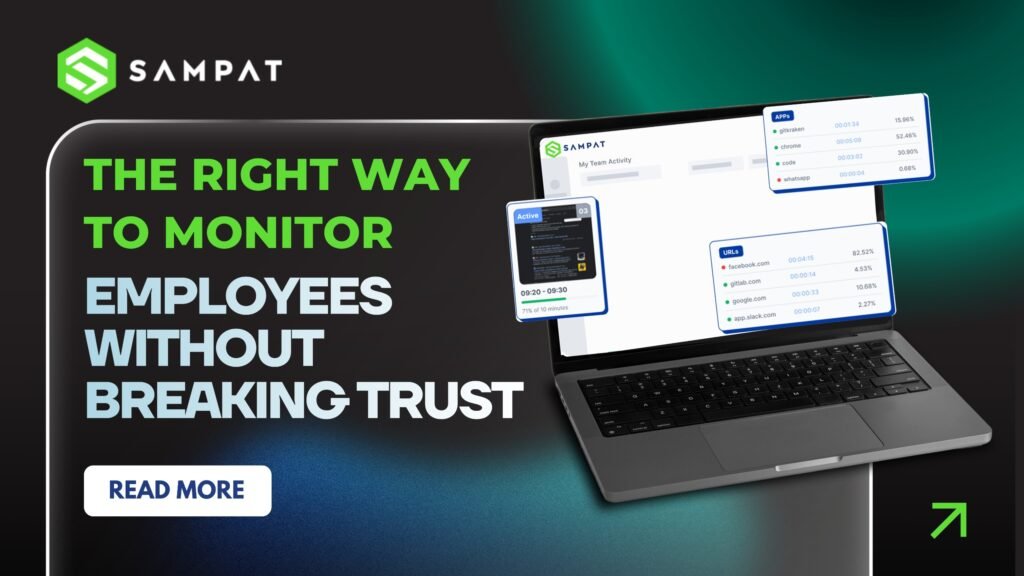
The Right Way to Monitor Employees Without Breaking Trust
The conversation around employee monitoring has changed dramatically over the past few years. Not long ago, monitoring was often associated with tracking attendance, logging work hours, or ensuring employees remained active during office hours. Today, organizations operate in a very different environment. Remote work, hybrid teams, distributed offices, and flexible schedules have transformed how businesses function—and how managers understand productivity. This shift has also introduced a new challenge. How do you maintain visibility into work without making employees feel like they’re constantly being watched? It’s a question that many business leaders are asking, and the answer isn’t found in more surveillance or stricter oversight. It’s found in adopting Employee Monitoring Best Practices that balance operational visibility with transparency, respect, and trust. The most successful organizations aren’t monitoring employees because they don’t trust them. They’re monitoring work so they can understand it better. And there’s an important difference.Monitoring Work Is Different from Monitoring People
One of the biggest misconceptions surrounding employee monitoring is that it’s designed to watch people. In reality, modern organizations don’t need to know every click an employee makes or every minute they spend at their desk. What they need is visibility into how work flows through the organization. Consider two project teams. Both have talented employees. Both work hard. Yet one consistently misses deadlines while the other delivers projects ahead of schedule. The difference may have very little to do with effort. Instead, it could be caused by fragmented workflows, inefficient processes, unnecessary meetings, or constant interruptions. Without meaningful operational data, managers often rely on assumptions. And assumptions rarely solve productivity challenges. The purpose of modern monitoring isn’t to measure human behavior—it’s to identify where work becomes inefficient and where teams need better support.Why Trust Matters More Than Technology
Organizations often spend weeks evaluating productivity platforms. They compare features. Dashboards. Reports. Analytics. Integrations. Yet one of the most important factors isn’t software at all. It’s communication. Employees are generally far more accepting of monitoring when they understand three things:- What information is being collected.
- Why it’s being collected.
- How it will be used.
Productivity Can’t Be Measured by Presence Alone
For decades, productivity was often associated with visibility. If someone was sitting at their desk, they were assumed to be working. Remote work challenged that assumption. Today, an employee can appear online all day while accomplishing very little. Another may complete complex, high-value work in focused sessions with fewer hours online. Presence is no longer a reliable measure of productivity. Results are. This is why forward-thinking organizations have shifted away from measuring activity alone. Instead, they’re asking better questions.- Where is work slowing down?
- Which processes consume the most time?
- Which applications contribute to productive work?
- Where do employees experience unnecessary interruptions?
- Which teams need additional support?
Good Data Creates Better Conversations
Managers often face a difficult situation. A project is delayed. Deadlines are slipping. Performance appears inconsistent. Without reliable data, discussions quickly become subjective. “I feel productivity has dropped.” “I think the team isn’t engaged.” “I believe we’re spending too much time on non-essential work.” These conversations are built on opinions. Data changes the discussion entirely. Imagine instead saying: “We’ve noticed that your team spends nearly three hours every day switching between five different business applications. Let’s explore whether we can simplify that workflow.” Or: “Your team is consistently spending more time waiting for approvals than actually completing tasks. Let’s see how we can improve the process.” Notice the difference. The conversation is no longer about blame. It’s about removing obstacles. That’s where modern productivity monitoring delivers its greatest value. It gives managers evidence they can use to support employees—not simply evaluate them.The Best Monitoring Is Often Invisible
When organizations hear the term “employee monitoring,” they often imagine dashboards filled with screenshots, activity logs, and detailed timelines. Ironically, the most mature organizations use those capabilities far less than people expect. Their focus isn’t constant observation. It’s operational intelligence. They’re more interested in understanding:- Why projects take longer than expected.
- Why one department consistently outperforms another.
- Why certain applications consume excessive time.
- Why workloads are unevenly distributed.
- Why collaboration breaks down between teams.
The Five Principles of Employee Monitoring Best Practices
Technology alone doesn’t determine whether monitoring builds trust or weakens it. The way an organization implements it makes all the difference. Businesses that successfully balance productivity with employee experience tend to follow a few common principles.1. Be Transparent from Day One
Monitoring should never come as a surprise. Employees deserve to know what information is being collected, why it is being collected, and how it contributes to business objectives. When organizations are open about their approach, monitoring becomes part of a broader conversation around performance, collaboration, and continuous improvement. Transparency also creates consistency. Everyone understands the same expectations, reducing uncertainty and building confidence across teams.2. Measure Work, Not Activity
It’s easy to measure keyboard activity, mouse movements, or login hours. It’s much harder—but far more valuable—to understand how work actually happens. An employee might spend hours researching, planning, solving a technical issue, or collaborating with colleagues. Those activities may not generate constant screen activity, yet they create significant business value. The goal should be to understand productivity patterns rather than simply recording activity. Organizations that focus only on activity metrics risk encouraging employees to look busy instead of doing meaningful work.3. Use Data to Remove Barriers
Productivity data should answer one important question: “What is preventing people from doing their best work?” Sometimes the issue isn’t employee performance at all. It could be:- Too many approval layers.
- Frequent context switching between applications.
- Repetitive administrative work.
- Poor workload distribution.
- Delays caused by manual processes.
4. Respect Privacy
Trust grows when organizations establish clear boundaries. Employees should feel confident that monitoring is limited to work-related activities and conducted during working hours. Equally important is ensuring that productivity information is accessed only by authorized personnel and used responsibly. Respecting privacy isn’t just good practice—it reinforces a culture built on professionalism and mutual respect.5. Turn Insights into Conversations
Dashboards don’t improve productivity. Conversations do. The purpose of productivity insights isn’t to generate reports that sit unused. It’s to create meaningful discussions between managers and employees. Instead of asking, “Why were you inactive yesterday?” A manager might ask, “We noticed you’re spending a significant amount of time switching between multiple systems. Is there something slowing down your work?” One question creates defensiveness. The other creates collaboration. That’s the difference between managing people and supporting them.A Practical Example
Consider two customer support teams with similar experience levels and workloads. Team A consistently resolves more tickets and reports higher customer satisfaction. Team B struggles to meet response targets despite working similar hours. Without operational data, it’s easy to conclude that Team B simply isn’t performing well. However, productivity analytics tells a different story. The data reveals that Team B spends a considerable amount of time switching between multiple applications to retrieve customer information. They also experience frequent delays waiting for approvals before resolving cases. The issue isn’t a lack of effort. It’s an inefficient workflow. Once these bottlenecks are addressed—by streamlining approvals and integrating systems—response times improve without increasing working hours or placing additional pressure on employees. This is the real value of modern productivity monitoring. It helps organizations improve the way work happens, rather than simply measuring the people doing it.Where Technology Fits In
Technology should support better management—not replace it. The most effective Employee Productivity Monitoring Software provides meaningful insights that help leaders understand work patterns while giving employees the opportunity to perform at their best. Features such as:- Active vs. Idle Time Analytics
- Application and Website Usage Insights
- Productivity Trends
- AI-Assisted Productivity Insights
- Configurable Activity Monitoring
- Secure Live Screen Support
- Offline Activity Synchronization