Why Work From Home Employee Monitoring Software Is Essential for Modern Businesses
Work From Home Employee Monitoring Software has become an essential tool for organizations managing remote and hybrid teams. As businesses continue to embrace flexible work models, maintaining visibility into productivity, collaboration, and operational efficiency has become a growing challenge.
What began as a temporary shift toward remote work has now evolved into a long-term workplace strategy across industries. While flexible work environments offer numerous benefits, they also make it harder for managers to understand how work is progressing, where productivity gaps exist, and how teams are performing overall.
In traditional office environments, productivity visibility happened naturally through direct observation and collaboration. In remote settings, that visibility is significantly reduced, creating a need for better workforce insights and operational transparency.
This is why many organizations are adopting modern productivity monitoring and workforce analytics solutions. The objective is no longer simply tracking activity—it is gaining meaningful insights that help improve efficiency, accountability, and business performance.
Remote Work Has Changed How Productivity Is Measured
For years, businesses associated productivity with attendance:
- office presence
- fixed working hours
- login duration
- manual reporting
But remote work has changed how performance should be evaluated.
An employee may remain online throughout the day without contributing meaningful output, while another employee may complete high-value tasks efficiently within fewer focused hours.
As a result, organizations are shifting toward the following:
- outcome-based performance
- workflow efficiency
- productivity insights
- collaboration effectiveness
- operational visibility
This evolution has increased demand for modern workforce productivity platforms that help organizations understand how work is actually happening across remote and hybrid environments.
Why Productivity Visibility Matters More Than Ever
Identifying Workflow Inefficiencies
One of the greatest challenges in remote work environments is that operational inefficiencies often remain invisible until they begin affecting business outcomes.
These inefficiencies may include:
- excessive meetings
- application switching
- idle work patterns
- communication delays
- fragmented collaboration
Without visibility into daily workflows, businesses struggle to identify where productivity is being lost.
Modern productivity monitoring tools help companies find problems in their operations early, so teams can fix workflows before delays affect delivery times and business success.
Improving Accountability Without Micromanagement
One of the most common concerns employees have about monitoring tools is privacy.
Today’s workforce expects flexibility, trust, and transparency. Businesses that rely on aggressive surveillance often damage workplace culture and employee morale.
Forward-thinking organizations are taking a different approach.
Instead of focusing on constant observation, they are using productivity analytics to:
- improve workflow transparency
- understand work patterns
- optimize team performance
- support operational efficiency
The purpose of modern productivity visibility is not to control employees — it is to help businesses understand how teams operate and where improvements can be made.
This balanced approach creates accountability while maintaining a healthier work culture.
Preventing Employee Burnout
Remote work can sometimes blur the boundaries between professional and personal life.
Many employees experience:
- longer working hours
- digital fatigue
- constant online availability
- increased stress
- reduced work-life balance
Without visibility into workload patterns, businesses may not recognize these issues until productivity and employee wellbeing begin to decline.
Workforce analytics can help managers identify unhealthy work trends and create more sustainable workflows. By understanding productivity patterns more clearly, organizations can improve workload distribution and support employee well-being more effectively.
The Operational Challenges of Remote Work
Managing distributed teams successfully requires solving several operational challenges.
Fragmented Communication
Remote teams rely heavily on the following:
- video meetings
- project management platforms
- messaging applications
- collaboration tools
- email communication
While these tools improve connectivity, they can also create fragmented workflows and productivity gaps if not managed effectively.
Limited Operational Visibility
In physical office environments, managers naturally observe collaboration and workflow movement throughout the day.
Remote work removes that visibility.
Such an environment creates uncertainty around:
- resource utilization
- team performance
- project progress
- employee engagement
- workflow efficiency
Without accurate insights, businesses often make decisions based on assumptions rather than real productivity data.
Difficulty Measuring Real Productivity
Traditional performance indicators such as attendance hours or login duration rarely provide meaningful productivity insights in remote environments.
Organizations now require deeper visibility into:
- productive work patterns
- operational efficiency
- collaboration effectiveness
- application usage trends
- workflow performance
This is driving the growing adoption of workforce analytics and productivity intelligence platforms.
The Shift Toward Productivity Intelligence
The future of workforce management is moving beyond basic activity tracking.
Businesses are increasingly adopting solutions that combine:
- workforce analytics
- productivity insights
- operational reporting
- workflow visibility
- efficiency tracking
Instead of asking:
“Are employees online?”
Organizations are now asking:
- Are workflows efficient?
- Where are operational bottlenecks?
- How productive are teams?
- Which processes reduce efficiency?
- How can performance improve?
This shift toward productivity intelligence is helping businesses make more informed operational decisions while improving workforce efficiency across remote and hybrid environments.
What Modern Productivity Monitoring Should Deliver
Modern organizations require more than basic employee tracking. They need actionable insights that help improve operational efficiency while supporting workforce performance.
An effective productivity monitoring platform should help businesses understand the following:
- productive versus idle work patterns
- workflow bottlenecks
- collaboration efficiency
- workload distribution
- application and website usage trends
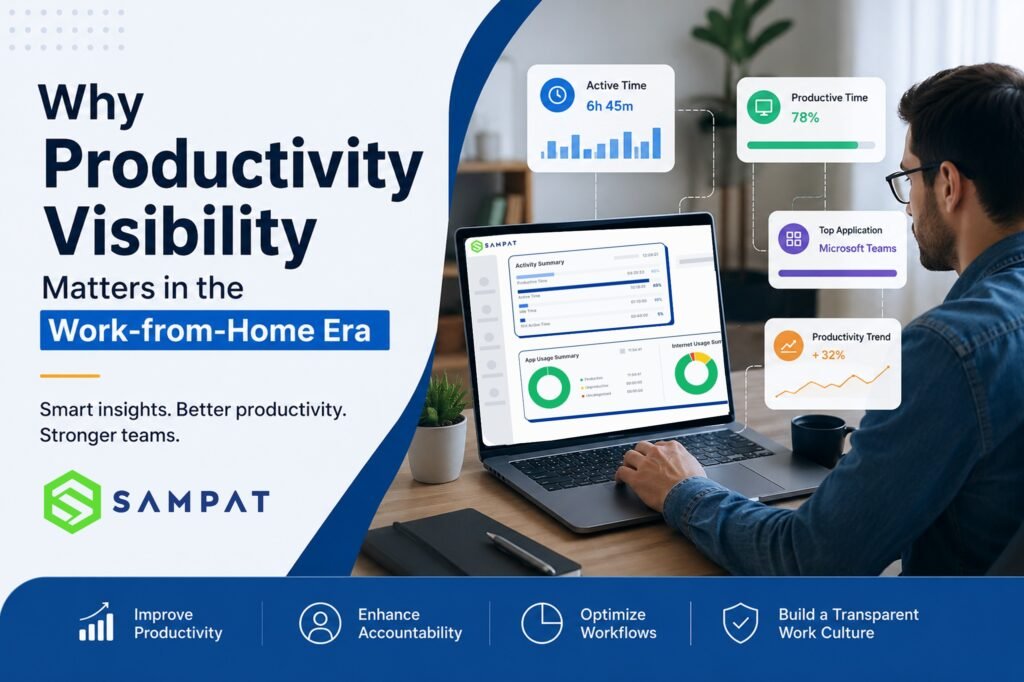
Solutions like SAMPAT Productivity Monitoring are designed to provide organizations with meaningful productivity insights while supporting transparent and professional workforce management practices.
Capabilities such as:
- Active vs. Idle Time Analytics
- Application & Website Usage Insights
- Activity Monitoring & Configurable Screenshots
- Live Screen Viewing & Remote Access
- Offline Activity Synchronization
- AI-Assisted Productivity Insights
help businesses improve operational visibility and better understand workforce efficiency across distributed teams.
Rather than relying on assumptions, organizations can use real productivity data to optimize workflows, improve planning, and strengthen overall operational performance.
How SAMPAT Supports Remote and Hybrid Teams
As businesses continue adapting to flexible work environments, the need for smarter workforce visibility is increasing.
SAMPAT Productivity Monitoring helps organizations
- Analyze productivity trends
- Improve operational visibility
- Identify workflow inefficiencies
- Optimize workforce planning
- Strengthen accountability across remote teams
The platform is especially valuable for:
- IT companies
- customer support teams
- BPO operations
- distributed project teams
- hybrid workplaces
- remote service organizations
By combining workforce analytics with AI-assisted productivity insights, SAMPAT helps businesses build more transparent, efficient, and productivity-focused work environments.
The Business Impact of Productivity Visibility
Organizations adopting modern productivity analytics solutions are seeing measurable operational improvements.
With better workforce visibility, businesses can:
- improve accountability
- reduce operational inefficiencies
- optimize staffing decisions
- identify training gaps
- improve workforce utilization
Many organizations also report:
- stronger operational planning
- improved workflow efficiency
- reduced idle time
- better resource allocation
- data-driven productivity improvements
As remote and hybrid work continue evolving, businesses that invest in productivity intelligence will be better positioned to improve performance and maintain operational efficiency.
The Future of Workforce Management
Remote and hybrid work models are becoming permanent parts of modern business operations.
Organizations that lack productivity visibility may struggle with:
- workflow inefficiencies
- project delays
- productivity loss
- reduced accountability
- operational blind spots
At the same time, businesses adopting intelligent workforce analytics solutions are gaining stronger operational control and better performance visibility.
The future of workforce management will depend on balancing the following:
- flexibility
- accountability
- employee experience
- operational efficiency
Modern productivity monitoring is no longer about surveillance. It is about helping organizations improve performance through meaningful workforce insights.
Improve Workforce Visibility with SAMPAT
As remote and hybrid work environments continue growing, organizations need smarter ways to improve productivity visibility and operational efficiency.
SAMPAT Productivity Monitoring helps businesses gain actionable workforce insights through:
- AI-assisted productivity analytics
- workforce activity monitoring
- operational reporting
- application usage analytics
- productivity visibility tools
Whether teams work remotely, in hybrid environments, or across distributed locations, SAMPAT helps organizations build transparent, efficient, and productivity-focused workflows for the future of work.