Employee Monitoring vs Employee Productivity: What Companies Should Actually Measure
Remote and hybrid work have transformed how organizations evaluate employee performance and operational efficiency. As teams become more distributed, businesses increasingly rely on employee monitoring software to gain visibility into daily work activities, collaboration patterns, and workforce engagement.
A few years ago, managers could easily observe productivity by being physically present in the workplace. Today, work happens across digital platforms, cloud applications, virtual meetings, and distributed teams. To adapt, organizations have adopted various monitoring tools to understand how work gets done.
However, many businesses have started confusing employee activity with actual productivity.
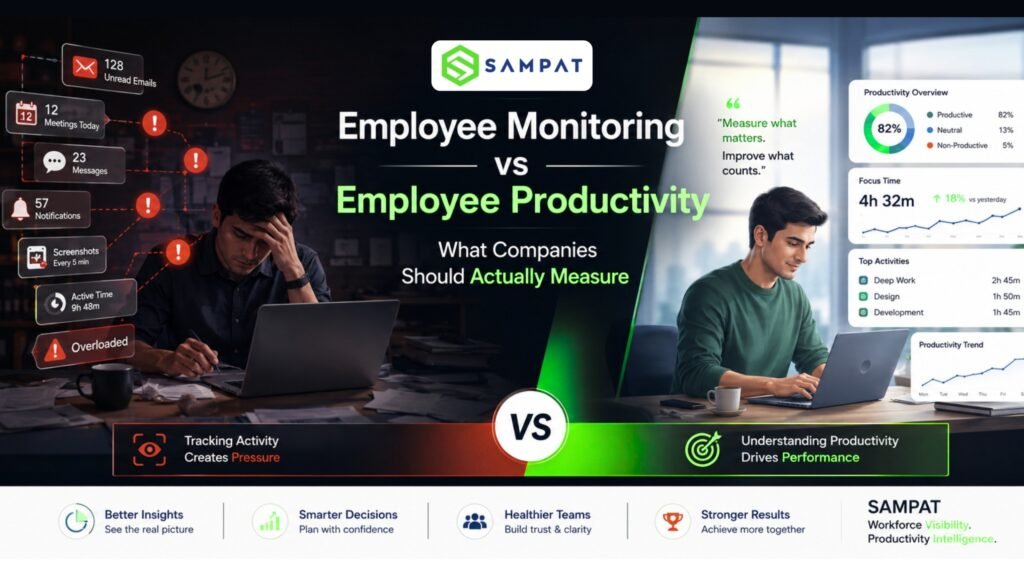
Modern employee monitoring software can track login duration, application usage, website activity, work hours, and online presence. While these metrics provide visibility, they do not always reveal whether meaningful work is being completed.
An employee may spend an entire day online, respond quickly to messages, and attend multiple meetings, yet accomplish very little. Meanwhile, another employee may spend a focused two-hour session solving a complex business problem that creates significant value.
This growing disconnect is causing organizations to rethink how they measure performance and why workforce productivity monitoring is becoming more important than traditional activity tracking alone.
Busy Doesn’t Always Mean Productive
One of the biggest challenges facing modern organizations is digital busyness.
Employees are surrounded by:
- Constant notifications
- Back-to-back meetings
- Endless emails
- Multiple collaboration platforms
- Frequent context switching
Although this activity appears productive on the surface, it often reduces focus and disrupts workflow efficiency.
Many organizations using employee monitoring software discover that high activity levels do not always translate into high performance. Employees may remain active throughout the day while struggling to complete deep, meaningful work.
This is not necessarily a performance issue. More often, it is a workflow and process challenge.
Activity Is Easy to Measure. Productivity Is Not
Traditional employee monitoring software focuses on metrics that are easy to capture:
- Active screen time
- Login duration
- Keyboard activity
- Application usage
- Online status
These indicators provide useful operational visibility, but they do not tell the full story.
Real productivity depends on factors such as:
- Focus and concentration
- Quality of work
- Collaboration effectiveness
- Workload balance
- Process efficiency
- Goal achievement
This is why organizations are increasingly investing in productivity analytics that provide context behind employee activity rather than simply measuring presence.
The Rise of Workforce Productivity Monitoring
Forward-thinking businesses are moving beyond simple activity tracking and adopting workforce productivity monitoring strategies that help leaders understand how work flows across teams.
Instead of asking:
- How many hours was an employee online?
- How many applications were used?
Organizations are now asking:
- Where is productive time being lost?
- Which workflows create bottlenecks?
- Are employees spending too much time in meetings?
- What factors reduce efficiency?
These questions generate actionable employee productivity insights that help improve business performance.
Visibility and Surveillance Are Not the Same Thing
One common misconception is that workforce visibility requires constant surveillance.
In reality, modern employee monitoring software should help organizations:
- Improve workflow visibility
- Identify operational bottlenecks
- Support better resource planning
- Enhance accountability
- Enable productivity improvements
When used correctly, monitoring tools provide valuable employee productivity insights that help teams work more effectively without creating unnecessary pressure or micromanagement.
A Smarter Approach to Productivity Management
The future of workplace performance lies in understanding how work happens rather than monitoring every action employees take.
Solutions like SAMPAT Productivity Monitoring combine workforce productivity monitoring, productivity analytics, and actionable employee productivity insights to help organizations identify inefficiencies, improve focus, and create healthier work environments.
Features such as:
- Active vs Idle Time Analysis
- Application & Website Usage Tracking
- Productivity Reporting
- Workflow Visibility
- Performance Trends
help businesses make informed decisions while supporting sustainable productivity growth.
Final Thoughts
The most successful organizations are not necessarily those that monitor employees more aggressively. They are the ones that use employee monitoring software strategically to improve workflows, reduce operational friction, and support focused work.
By combining operational visibility with meaningful productivity analytics and employee productivity insights, businesses can build stronger teams, improve efficiency, and create work environments where employees can perform at their best.