The Hidden Productivity Challenges Affecting Remote Teams Today
Remote work has changed the way businesses operate — permanently.
What began as a short-term adjustment has evolved into a long-term workplace model embraced by organizations across industries. Teams are now collaborating across cities, time zones, and even continents while maintaining levels of flexibility that traditional office environments rarely offered.
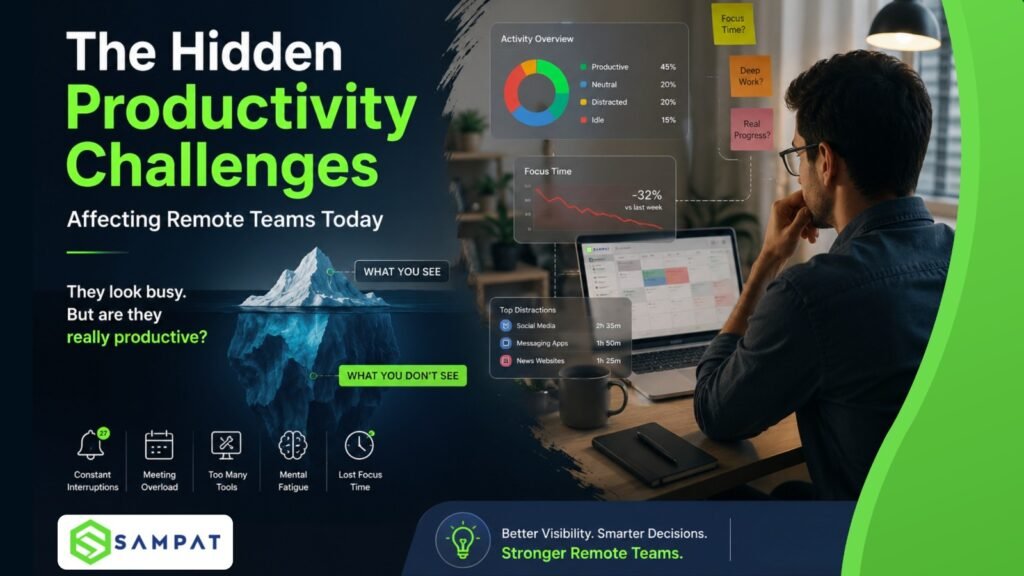
On the surface, everything appears efficient.
Employees are active on communication platforms. Meetings continue throughout the day. Tasks move across project management systems. Notifications constantly appear. Status indicators remain green for hours.
From a management perspective, remote work can often look highly productive.
But inside many organizations, another reality quietly exists.
Deadlines take longer than expected.
Employees feel mentally exhausted.
Focus time continues shrinking.
Managers struggle to identify where productive hours are actually going.
And despite everyone appearing “busy,” operational efficiency often feels inconsistent.
This is one of the most overlooked challenges in modern business today:
remote teams can appear productive while silently struggling with hidden workflow inefficiencies.
The Modern Workplace Is Busy — But Not Always Effective
One of the biggest misconceptions about remote work is the belief that digital activity automatically reflects productivity.
It does not.
In many remote environments, employees spend entire days moving between:
- meetings
- chat notifications
- emails
- collaboration tools
- status updates
- project discussions
By the end of the day, employees may feel exhausted despite accomplishing very little meaningful work.
This creates what many organizations are now experiencing:
a culture of continuous activity without consistent productivity.
The issue is rarely employee effort.
In fact, remote employees are often working longer hours than before.
The real challenge is that modern workflows are becoming increasingly fragmented, making it difficult for teams to maintain focus, clarity, and operational efficiency throughout the day.
The Productivity Loss Most Businesses Never See
Traditional office environments provided natural visibility into workflows.
Managers could observe collaboration patterns, workload distribution, and employee engagement simply through day-to-day interaction.
Remote work removed that visibility.
Now, many operational inefficiencies remain invisible until they begin affecting:
- project delivery
- customer response times
- collaboration quality
- employee wellbeing
- overall business performance
The problem is not always obvious.
Productivity loss often happens quietly through small daily inefficiencies that accumulate over time.
A delayed approval here.
An interrupted workflow there.
Too many meetings.
Too many tools.
Too little uninterrupted focus.
Individually, these may seem minor.
Collectively, they create serious operational friction.
When “Always Online” Becomes a Workplace Problem
In many remote workplaces, employees feel pressure to remain constantly available online.
This pressure is subtle but powerful.
Employees hesitate to:
- step away briefly
- decline unnecessary meetings
- disconnect after work hours
- take uninterrupted focus time
As a result, many people stay digitally active throughout the day simply to appear engaged.
This behavior is often called digital presenteeism — the habit of maintaining online visibility regardless of actual productivity.
The long-term effects can be damaging:
- mental fatigue increases
- creativity declines
- work quality suffers
- burnout rises
- productivity becomes inconsistent
Ironically, employees who appear highly active online may actually be struggling the most with focus and efficiency.
Meetings Are Quietly Replacing Productive Work
One of the most common productivity challenges affecting remote teams today is meeting overload.
Virtual collaboration has become essential for distributed work environments. But many organizations unintentionally compensate for reduced physical visibility by increasing meetings.
Quick check-ins become daily calls.
Daily calls become multiple sync meetings.
Collaboration slowly turns into calendar management.
The result?
Employees spend large portions of their day discussing work instead of completing it.
Deep work — the uninterrupted time required for problem-solving, analysis, creativity, and focused execution — becomes increasingly rare.
This creates an operational pattern where teams remain highly engaged in communication but struggle to maintain momentum in execution.
Over time, this directly affects workforce efficiency.
Too Many Tools, Too Little Clarity
Modern remote teams rely on an expanding ecosystem of digital tools:
- communication platforms
- project management systems
- collaboration software
- reporting dashboards
- cloud storage applications
- workflow trackers
While these tools improve connectivity, they also create constant context switching.
Employees move between applications dozens of times every hour, interrupting concentration and reducing workflow continuity.
Research consistently shows that excessive task switching increases mental fatigue while reducing cognitive performance.
Yet many organizations continue measuring productivity based primarily on responsiveness rather than focusing on quality.
This creates a dangerous imbalance:
Teams become highly reactive but less effective.
Visibility Matters More Than Surveillance
One of the biggest mistakes businesses make is confusing productivity visibility with employee surveillance.
Modern workforce visibility is not about monitoring every employee action.
It is about understanding:
- where workflows slow down
- which processes reduce efficiency
- how collaboration impacts productivity
- where teams lose focus time
- how workloads affect performance
Businesses today do not need more micromanagement.
They need better operational clarity.
This is why organizations are increasingly shifting toward productivity intelligence and workforce analytics rather than traditional monitoring approaches.
The goal is no longer to simply track activity.
The goal is to improve how work actually happens.
The Most Productive Teams Usually Share One Common Trait
Highly productive remote teams are rarely the ones working the longest hours.
Instead, they are the teams with:
- clearer workflows
- healthier collaboration habits
- fewer interruptions
- better workload visibility
- stronger operational alignment
Productivity improves significantly when employees are given:
- uninterrupted focus time
- realistic workload expectations
- clear priorities
- efficient workflows
- reduced digital friction
Organizations that understand this are moving away from measuring “time online” and focusing more on workflow quality and operational efficiency.
Why Businesses Are Investing in Productivity Intelligence
As remote and hybrid work environments continue evolving, businesses are realizing that operational visibility is becoming a strategic advantage.
Leaders now need answers to questions like:
- Where are inefficiencies affecting productivity?
- Which workflows create delays?
- Are teams overloaded?
- How effectively are employees utilizing work hours?
- What patterns are reducing workforce performance?
Modern productivity analytics platforms help organizations identify these hidden operational trends before they become larger business problems.
Solutions like SAMPAT Productivity Monitoring support organizations by providing visibility into:
- productive versus idle work patterns
- application and website usage trends
- workflow bottlenecks
- workforce activity insights
- operational efficiency indicators
Capabilities such as:
- Active vs. Idle Time Analytics
- AI-Assisted Productivity Insights
- Workflow Visibility
- Application Usage Analytics
- Offline Activity Synchronization
- Activity Monitoring & Reporting
help businesses better understand workforce behavior while supporting more efficient remote operations.
Instead of relying on assumptions, organizations gain actionable insights that improve workforce planning, productivity visibility, and operational decision-making.
Remote Productivity Is Becoming a Leadership Priority
Remote work is no longer an experimental workplace model.
It is now part of how modern businesses operate.
As organizations continue adapting to distributed and hybrid environments, productivity challenges can no longer be addressed through surface-level visibility alone.
Leaders must now understand:
- how teams collaborate
- where workflows break down
- what reduces focus
- how operational friction impacts performance
- how to build healthier and more sustainable work environments
The companies that succeed in the future of work will not necessarily be the ones monitoring employees more aggressively.
They will be the ones creating smarter, clearer, and more efficient ways for teams to work.
Final Thoughts
The biggest productivity challenges affecting remote teams today are often the ones businesses cannot immediately see.
Constant digital activity can create the illusion of productivity while hidden inefficiencies quietly reduce operational performance in the background.
Meeting overload, fragmented workflows, digital presenteeism, and continuous context switching are becoming major obstacles for modern remote teams.
Organizations that focus only on surface-level activity metrics may struggle to identify these deeper operational issues. But businesses that prioritize productivity visibility, workflow clarity, and operational intelligence will be better positioned to build healthier, more efficient, and higher-performing teams in the years ahead.
As remote and hybrid work continue evolving, many organizations are also exploring modern productivity analytics platforms like SAMPAT Productivity Monitoring to better understand
workforce patterns, improve operational visibility, and support more efficient ways of working — without compromising flexibility or collaboration.