
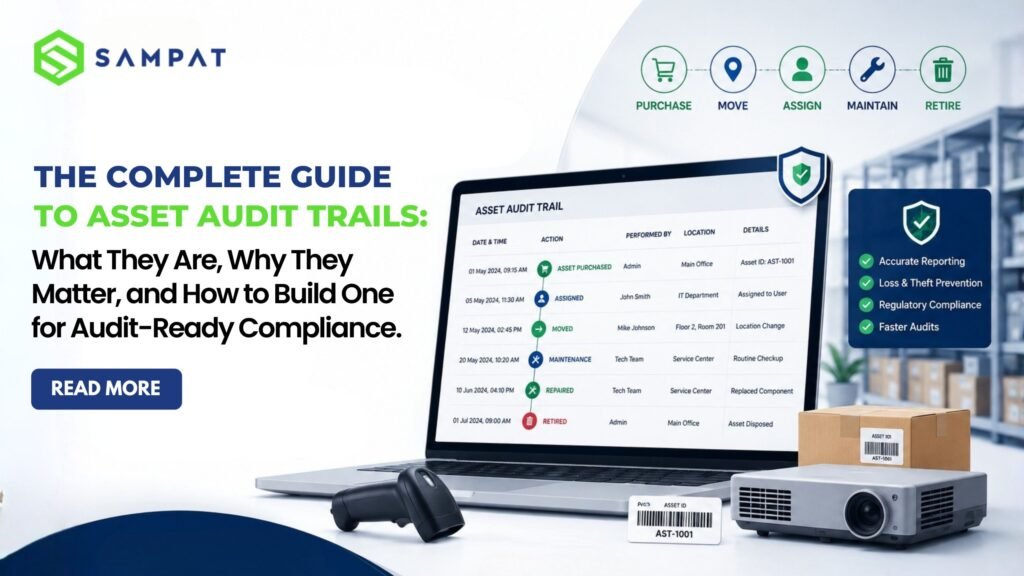
An asset audit trail is the documented history of everything that happens to an asset — from purchase to retirement. It records who moved it, when, why, and where it ended up. Without one, businesses fail audits, misreport asset values, and lose track of equipment worth thousands of dollars.
This guide breaks down what a proper audit trail includes, why most businesses don’t have one even when they think they do, and how to build a system that holds up under real scrutiny.
In this blog:
- What an Asset Audit Trail Actually Covers
- Why Businesses Struggle With This
- What a Strong Audit Trail Protects You From
- How to Build an Audit Trail That Actually Holds Up
- Where Most Businesses Should Actually Start
- FAQ
An asset audit trail is simply the documented history of everything that’s happened to a physical or IT asset from the day it entered your business to the day it leaves. Where it is. Who’s responsible for it. When it moved, changed hands, got repaired, or got written off. Done right, it’s the backbone of accurate reporting, regulatory compliance, and honestly, your own sanity when finance asks “where did this go?”
Done wrong — or not done at all — it’s how businesses end up with six-figure write-offs for assets nobody can locate, failed compliance checks, and insurance claims that get denied because there’s no proof the asset existed or was maintained.
At Sampat Suite, we work with businesses across manufacturing, healthcare, and IT every day who come to us after a failed or painful audit — not before. So let’s walk through what a real audit trail looks like, why so many businesses get this wrong, and how to build one that survives actual scrutiny, before you’re the one explaining a gap to an auditor.
What an Asset Audit Trail Actually Covers
A proper audit trail isn’t just a spreadsheet with a “last updated” column. It’s a core function of any real asset management system — not a bolt-on report you generate once a year. It’s a chronological, tamper-resistant record that answers five questions for every single asset:
- What happened — was it purchased, moved, assigned, serviced, depreciated, or retired?
- Who did it — which employee, technician, or department made the change?
- When it happened — exact date and timestamp, not “sometime last quarter.”
- Where it happened — the physical or system location at the time of the event.
- Why it happened — the business reason: transfer, repair, disposal, compliance requirement.
If your current system can’t answer all five for every asset, you don’t have an audit trail. You have a partial history with gaps — and gaps are exactly what auditors, and regulators, are trained to find.
Why Businesses Struggle With This
Most companies don’t set out to have bad audit trails. It happens gradually. Someone tracks assets in a spreadsheet because it’s fast. Then a department starts using a different tool. Then a warehouse manager keeps a paper log because “that’s how we’ve always done it.” Fast forward two years and nobody can produce a single, trustworthy record of an asset’s full life.
A few things drive this:
Manual tracking breaks down at scale. Spreadsheets don’t log who changed a cell or when. Once more than a handful of people are updating asset records, you lose the ability to prove anything.
Ownership gets fuzzy. An asset moves from IT to a field team to a contractor and back. Without a system enforcing custody handoffs, that chain of ownership just disappears.
Audits become reactive. Most businesses only think hard about their audit trail right before an actual audit — which is the worst time to discover it’s incomplete.
Compliance requirements differ by industry, and generic tracking methods usually don’t hold up. Healthcare, pharma, finance, and manufacturing all have specific documentation standards, and “we have a list somewhere” doesn’t satisfy any of them.
A quick gut check: if an auditor asked you right now to prove the location and maintenance history of your ten highest-value assets, could you pull that up in under five minutes? If not, the gaps below are worth closing before they cost you. See how Sampat Suite automates this →
What a Strong Audit Trail Protects You From
This isn’t just about passing an audit, though that alone is reason enough. A solid trail protects the business in ways that show up on the balance sheet:
Financial accuracy. You can’t depreciate, insure, or budget for assets you can’t verify. Ghost assets — items still on the books that no longer physically exist — are one of the most common findings in financial audits, and they directly distort your numbers.
Loss and theft prevention. When every movement is logged and attributed to a person, assets are far less likely to quietly disappear. Accountability changes behavior — this is one of the most common “aha” moments customers tell us about after switching to a system that logs custody changes automatically instead of trusting people to remember.
Regulatory compliance. Industries like healthcare, pharmaceuticals, and finance require documented custody and maintenance history as a legal condition of operating. No trail, no compliance — regardless of how good your actual asset management is.
Insurance and warranty claims. Try filing a claim on damaged equipment without proof of purchase date, maintenance history, or custody. Insurers deny claims on missing documentation constantly.
Faster, cheaper audits. When the trail already exists, an audit becomes a data pull instead of a scramble. That’s the difference between a two-day process and a two-week one.
How to Build an Audit Trail That Actually Holds Up
Start with a full asset inventory. You can’t build a trail for assets you haven’t formally recorded. This means physical verification, not just trusting what’s on a list from three years ago.
Assign a unique identifier to every asset. Barcodes, RFID tags, or serial number tracking — pick one and apply it consistently. This is what makes every later log entry traceable to one specific item instead of “one of the laptops.”
Automate the logging. Every checkout, transfer, repair, and disposal should log itself automatically the moment it happens, tied to the person who did it. Manual entry is where audit trails quietly fall apart — people forget, or they log it “later,” which means it never actually gets logged. This is the exact gap Sampat Suite was built to close: every scan, transfer, and status change is captured in real time, with no manual re-entry required.
Set custody rules. An asset should always have one clearly assigned owner or location. When it moves, the system should require a handoff — not just an update someone remembers to make. In Sampat Suite, a transfer can’t happen without the system recording who released the asset and who accepted it, so there’s never a point where an item is “in transit” with nobody accountable for it.
Schedule recurring reconciliation. Don’t wait for an annual audit to check if your records match reality. Quarterly spot checks catch discrepancies while they’re still small and explainable.
Keep records tamper-resistant. Audit trails only have value if they can’t be quietly edited after the fact. Look for systems with locked historical logs, not just editable spreadsheet history.
Where Most Businesses Should Actually Start
If this all sounds like more infrastructure than you currently have, you’re not alone — this is the most common gap we see. The good news is you don’t need to overhaul everything at once. Start with your highest-value or highest-risk assets, get automated tracking in place for those, and expand from there.
What you shouldn’t do is keep patching together spreadsheets and hope nothing gets questioned. The businesses that get caught off guard are almost always the ones that assumed their manual process was “good enough” until an auditor, insurer, or regulator proved otherwise.
FAQ
What is an asset audit trail?
It’s the complete, timestamped record of everything that’s happened to an asset — purchase, movement, custody changes, repairs, and disposal — used to verify accuracy during financial, compliance, or insurance audits.
How often should an asset audit be done?
Most businesses benefit from quarterly reconciliation checks plus a full annual audit. Industries with strict compliance requirements, like healthcare or pharma, often need more frequent checks.
What’s the difference between an asset audit and an asset audit trail?
An audit is the event — a point-in-time check of your records against reality. The audit trail is the ongoing documentation that makes that event fast and accurate instead of a weeks-long scramble.
Can spreadsheets be used for an audit trail?
Technically yes, but they don’t log who changed what or when, can be edited after the fact, and break down once more than a couple of people are involved. They’re a starting point, not a long-term solution.
Ready to Fix Your Audit Trail Before Your Next Audit?
That’s exactly what we built Sampat Suite to handle — a system that logs every movement, assigns every custody change automatically, and gives you a clean, exportable history the moment you need it. Talk to our team about setting one up.